The Great Glen Way: Complete Guide to Distances, Stages, and What to Expect
Most people planning a long-distance walk in Scotland go straight to the West Highland Way. Fair enough, it's better known. But the Great Glen Way is worth serious consideration, and walkers who've done both often say it gets underestimated.
What Is the Great Glen Way?
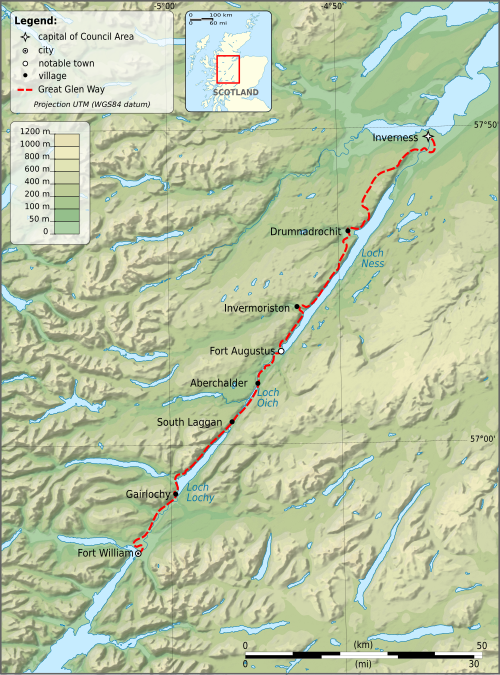
It's a long-distance walking route from Fort William in the west to Inverness in the east, following the Great Glen, the geological fault line that splits Scotland almost in half. The glen carries a chain of lochs, Lochy, Oich, and Ness, connected by the Caledonian Canal, and most of the walking follows that corridor rather than going up and over anything.
That's the thing that surprises people. They expect Highland mountain walking and get towpaths and lochside tracks for the first few days instead. Not a complaint once you're out there, but worth knowing before you pack your bags. The terrain does get rougher once the canal ends and the route climbs into the forest above Loch Ness, but by then you'll have found your legs.
Cyclists and horse riders share parts of the route, so peak summer weekends can get busy in places.
How Far Is the Great Glen Way?
Around 79 miles, or 125 to 127 km. The small variation between sources comes down to how different maps handle certain sections and whether you take any of the high-level route options, but 79 miles is the number most people plan around.
It's shorter than the West Highland Way, though that shouldn't be the deciding factor in how many days you give yourself. The distance is manageable, but six consecutive days of walking accumulates regardless.
Fort William to Inverness: The Start, Finish, and Direction
Fort William is the start, Inverness is the finish. Walk it west to east and the prevailing winds tend to be behind you for most of the trip, which over 79 miles makes a noticeable difference to how the days feel.
Both towns are on the rail network, which keeps the logistics simple whether you're travelling up from the central belt or heading back after you finish.
If you're planning to arrive the night before, Spean Bridge is worth considering as an overnight stop. It's about 9 miles north of Fort William and sits right in the Great Glen, with the route passing through the village area, so you're already closely positioned to the start. Achnabobane Farmhouse is a bed and breakfast there that suits walkers well.
How Long Does the Great Glen Way Take?
Five to seven days is the typical range. Six is probably the most common choice because the daily distances feel manageable without much padding, and seven gives you more breathing room and a bit of slack if the weather turns or your knees start complaining.
Five days is possible but leaves almost no room for error. Bad weather, a slower section than expected, or just tiredness by day four can make five days feel tight. First-timers tend to enjoy it a lot more with six.
Great Glen Way Stages: How the Route Breaks Down
There's no single official stage split. Different guidebooks and itineraries divide the distance differently, so rather than presenting one version as the standard, it's more useful to know the main stopping points: Fort William, South Laggan, Fort Augustus, Invermoriston, Drumnadrochit, and Inverness. Most walkers build their days around those.
A common six-day spread uses these sections, with approximate distances:
Fort William to South Laggan The canal from Fort William's Neptune's Staircase, a flight of eight locks, heads north towards Loch Lochy. It's flat, well-signed, and genuinely easy going, which makes it a good first day for settling into the pace rather than testing yourself. Around 21 km.
South Laggan to Fort Augustus More canal and lochside walking, still mostly flat, finishing where the Caledonian Canal meets Loch Ness at Fort Augustus. Good spot to restock. Around 17 km.
Fort Augustus to Invermoriston The canal ends here and the route climbs into the forest above Loch Ness, where the ground gets steeper and less predictable than the towpath days, and the navigation needs a bit more attention. Around 17 km.
Invermoriston to Drumnadrochit Forested walking continuing above the loch. Drumnadrochit is roughly two-thirds of the way along the whole route, so getting there feels like a genuine milestone. Around 21 km.
Drumnadrochit to Inverness The longest day, and the one that breaks people's optimism a bit. Not technically hard, just long, at around 30 to 32 km of mixed tracks, paths, and some road. By this point you've had five days in your legs already, and you'll feel every one of them.
Depending on pace and accommodation, many walkers split the Fort William to South Laggan section across two days, which is how a six-day trip typically comes together. All distances are approximate, and the Highland Council's route information and Walkhighlands both carry up-to-date stage details if you want to plan more precisely.
How Hard Is the Great Glen Way?
Less hard than most people expect, and that's not entirely a good thing. It's genuinely accessible for walkers who aren't experienced hillwalkers, with no summits, no scrambling, and no technical terrain, but that accessibility can lead people to underestimate the cumulative toll of six days on the move.
The forested section between Fort Augustus and Drumnadrochit is where the route earns a bit more respect. The paths are rougher, the climbing is more sustained than anything in the first half, and the waymarking needs more attention than the earlier towpath days. It's not difficult by any objective standard, just different from what came before. The final stretch into Inverness is tiring for a simpler reason: there's just a lot of ground to cover.
If you're walking 10 to 15 km comfortably on back-to-back days before you go, you're in reasonable shape for it.
The High-Level Route: Is It Worth Taking?
Between Fort Augustus and Drumnadrochit, high-level variants climb above the main forest path, and the views down to Loch Ness from up there are worth it on a clear day. You don't get much sense of the loch's scale from water level, so seeing it spread out below you is one of the better moments on the whole route.
They add extra ascent and the waymarking is patchier, so they're not a given. In bad weather or with tired legs, the main route is the sensible call.
A Few Things Worth Sorting Before You Go
Footwear matters more than people tend to budget for. The early canal sections are forgiving enough in lighter shoes, but the forest above Loch Ness is uneven enough that proper walking boots with ankle support make a real difference by the time you reach the harder days.
Scottish weather changes quickly and you'll almost certainly hit rain at some point across six days, so decent waterproofing is worth the investment regardless of what the forecast says when you leave home.
Book accommodation early if you're going in summer, particularly in Fort Augustus and Drumnadrochit. Both have only a handful of options between them and they fill up quickly, so leaving it late usually means a detour off-route to find a bed.
The route is well-waymarked overall, but carrying a paper map is sensible because the forested sections above Loch Ness can be disorienting and phone signal is patchy along much of the loch.
Walk it west to east. The prevailing wind direction alone is reason enough, and the recommended direction on every itinerary points the same way.
Finishing in Inverness
You arrive in a city, which after nearly a week of lochs and forest feels like a lot all at once. There's no formal finish line or marker, so it's a quietly anticlimactic end, but the trains home run regularly and by then you'll have covered 79 miles of some genuinely beautiful country.
Is the Great Glen Way Right for You?
If ridge days and summits are what you're after, this probably isn't it. The route stays in the glen the whole way, which is either the appeal or the limitation depending on what kind of walker you are. For anyone who wants a genuine multi-day Highland walk without needing mountain experience or technical kit, it's a good fit.
If you need a base near the Fort William end the night before you start, Achnabobane Farmhouse in Spean Bridge is a bed and breakfast situated just outside of Fort William where the trail begins.
Collection and return to Gairlochy from Achnabobane Farmhouse may be possible, please call in advance for further information and advice.